Justice,
Psychology, and Religion Part 1
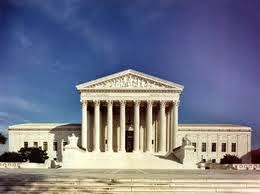
On the street, U.S. news watchers refer to June 30 2014 headlines
and say, “Hobby Lobby won and women lost." As with many difficult cases, the
decision was split 5-4 in Burwell v. Hobby Lobby Stores, Inc. Justice Alito
wrote the majority opinion and Justice Ginsburg wrote the dissenting opinion.
The decision stimulated much talk. Many social issues
came to the fore-- women’s rights, religious freedom, birth control, and religious
beliefs held by owners of private companies.
The 5-4 split is not just a matter of
reasoned opinion.
The winners were joyful. There’s an anger driven reaction as well. Here’s a quote from the New York Times
“Those who are bound by our decisions usually believe they can
take us at our word,” Justice Sotomayor wrote. “Not so today.”
The court’s action, she
added, even “undermines confidence in this institution.”
How religion
affects justice.
I found a helpful summary of research linking a judge’s
religion to decision-making. The article by Brian Bornstein and Monica Miller
is available online.
The attitudes of the Supreme Court justices predicts
which cases they select for review, who writes the majority opinion, and the
outcome.
Conservative and
Liberal Outcomes
Conservative vs. liberal beliefs are good predictors of
how Supreme Court Justices vote in matters of criminal defendants or prisoner
rights.
Stuart Nagel (1964 & 1969) analyzed decisions by 313
judges in 1955 and found that Catholic judges were more liberal than Protestant
Judges in several types of cases-- for example divorce settlements and employee injury.
Sheldon Goldman (1966 & 1975) also found Catholic
judges to be more liberal in some types of cases than were Protestant judges. It
appears to have been better to have a Catholic judge if you were injured or suffered
economic harm.
When it comes to LGBT issues, Jewish judges were more
liberal than were Protestant or Catholic judges for the years 1981-2000 (Daniel
Pinello, 2003).
Death, Sex,
Obscenity and Religion
Decisions about death penalty, gender discrimination, and
obscenity were analyzed by Songer and Tabrizi.
Evangelical judges were more
conservative than were Jewish and Protestant judges.
The likelihood of support
for the death penalty, gender discrimination, and restricted speech was higher
for Evangelical judges. Jewish judges were more liberal. Judges associated with
mainline Protestant groups were liberal in death penalty and obscenity cases.
Catholic judges were conservative in matters of obscenity, liberal on gender
discrimination decisions, but middle of the road on death penalty cases.
Religious Freedom
Barbara Yarnold studied 1,356 cases between 1970 and
1990. All judges supported religion but Catholic and Baptist judges were the
most pro-religious.
In a study of 729 cases by Gregory Sisk (2004) and others,
religion had the greatest influence on judicial decision-making.
THOUGHTS
Religion is often bound up with matters of morality and
justice.
Religious
and nonreligious persons do well to understand the religious beliefs of
decision makers.
The religious beliefs of judges often predict how they
will decide.
Men often decide what happens to women.
Gender matters--no woman on the U.S. Supreme Court supported the majority decision. (There were three female justices on the U.S. Supreme Court at the time).
Highly intelligent people disagree on the right course of
action.
Intelligence is a necessary but not a sufficient basis
for making a moral judgment.
Reason can lead to right and wrong outcomes in matters of
morality and justice.
Logical reasoning is only a tool,
which can be used for good or evil.
The lives of millions of people can be affected by the
decision of one person.
References
For the empirical studies cited in this post, see the
Bornstein and Miller article, Does
a Judge’s Religion Influence Decision Making? Published in Court Review Volume 45.
For a summary of the influence of conservative Christian
values on U.S. Law, see the recent summary by Brad Reid:
Reid, B. (2012). An Overview of Conservative Christian Religious Cultural Norms and U.S. Law. Culture & Religion Review Journal, 2, 1-18.
Link to the slip opinion on the Burwell vs.
Hobby Lobby case.
I reviewed the research on judges in my book, A House Divided: Sexuality, Morality, and Christian Cultures- see a free sample on AMAZON.
Note- I may earn income if you purchase advertised items.
Links to Connections
My Page www.suttong.com
My Books AMAZON and GOOGLE STORE
FOLLOW
FACEBOOK Geoff W. Sutton TWITTER @Geoff.W.Sutton
PINTEREST www.pinterest.com/GeoffWSutton
Articles: Academia
Geoff W Sutton ResearchGate
Geoffrey W Sutton
Comments
Post a Comment