Surprised by hate

From CNN.com

I am simply stunned by the hatred and violence toward those who have been shot and injured in Orlando Florida today. Words like outrage and horror come to mind.

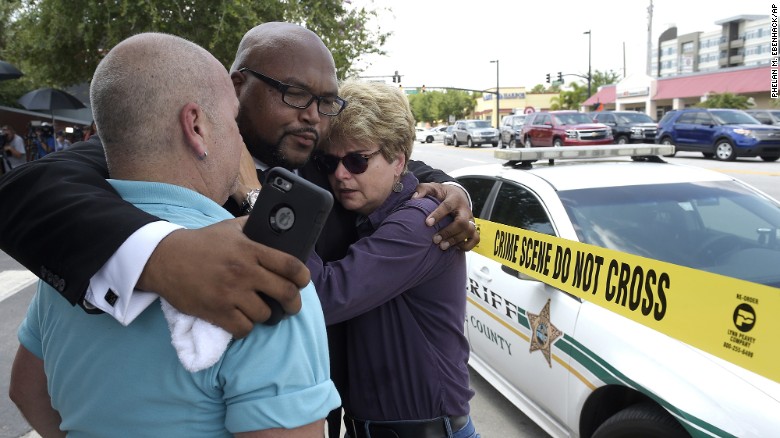
The picture of pastor Kelvin Cobaris hugging two people is the kind of response I would hope to see from more clergy, regardless of their faith.

As a nation, we need to see religious leaders and secular leaders binding people together to help those in need and guiding all to replace the rhetoric of hated with the language of love and respect.

The focus must always be on the survivors struggling to stay alive and those with months of rehabilitation ahead. And the families will need much support. There is little meaning to be found in such a powerfully destructive act.

Some have wondered about the motives of the mass murderer. Some even say motives do not matter. There will be inquiries of course. And I do hope some information helps homeland security make the USA a safer place.


Comments

Popular posts from this blog

EASTER: VARIATIONS IN BELIEF

Differences in Religious & Spiritual Beliefs Relevant to the Easter Story By Geoffrey W. Sutton, Ph.D. at suttong.com Like most Christians, my wife and I attend an Easter Service. And, a s usual, the media rise to the Spring occasion with Bible stories, comments from various religious leaders and a few atheists—just to keep things balanced. Other religions are on the back burner until Monday. So many statements of beliefs come from the Easter events.  For now, here’s a sample of some core beliefs from various sources. God: 51% believe in God as in the Bible Statista (May, 2023) reported US belief "in God as described in holy scriptures" at 51%. Another 22% reported a belief in a higher power or spirit. Pew researchers from 2021 find 58% believe in God as described in the Bible and another 32% believe in a God or Higher Power.  Belief in God is obviously a core belief. U.S. belief has declined to 58% having no doubt God exists and another 17% have do...

9 Beliefs of Christian Counselors

Updated 26 Feb 2018 What Christian Counselors Believe, Value, and Practice Part I: Beliefs I once asked a conservative evangelical Christian Chaplain how he handled counseling when he was pretty sure a dying patient was not a Christian and, according to his tradition, would soon spend eternity in hell. He sincerely said he would have to think about that question. A female health care provider told me she switched jobs so she could work with children rather than seniors, because she believed that, unlike the elderly, children would go to heaven if they died. In this case, her Christian beliefs appeared to have a cause -effect influence on her career. Counselors normally focus on the needs of clients and help clients find solutions in a supportive setting. Theoretically, rapport ought to be enhanced when counselors and clients share common values and beliefs.  Why ask what Christian Counselors Believe? The primary reason ...

The Turing Test and Chat Psychotherapy 2025

  Where are we now? The Turing Test, originally called the "Imitation Game," is a concept proposed by Alan Turing in 1950 to address the question, "Can machines think?". Instead of trying to define the complex notion of "thinking," Turing suggested a practical test to determine whether a machine could exhibit behavior indistinguishable from that of a human (Vation Ventures.com). How it works Participants: Three individuals participate: The Interrogator (Judge): A human whose goal is to determine which of the other two participants is human and which is a machine. Human Participant: A human who aims to convince the interrogator that they are human. Machine Participant: A computer program that strives to imitate human conversation and responses so effectively that the interrogator cannot reliably distinguish it from the human participant. Communication : All three participants are isolated from each other and communicate solely through a text-based interf...